Dietitians of Alaska
Guiding You To Better Health
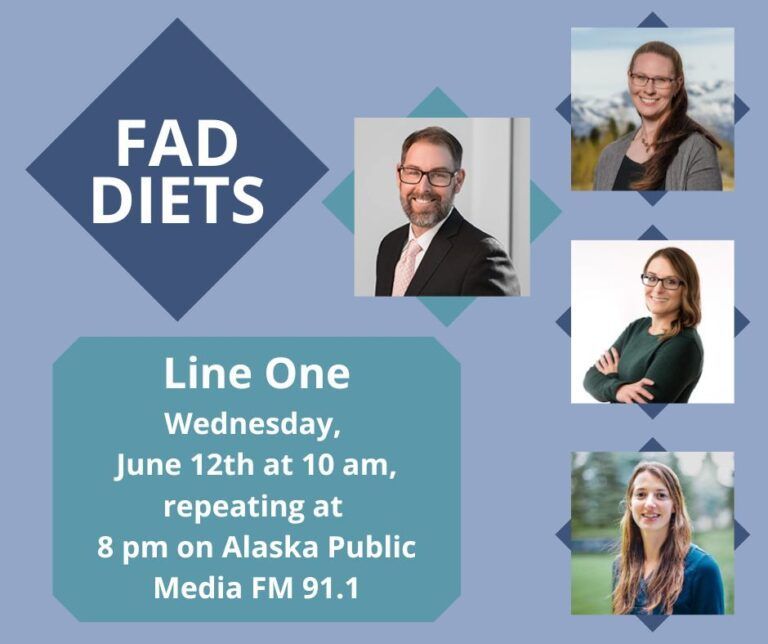
Line One: Dietitians of Alaska – Deconstructing fad diets
What do intermittent fasting, paleo, and keto all have in common? These are fad diets that offer rapid weight loss and a magic bullet to improve chronic diseases. While they are popular, many of these diets have limited data to support their claims, and in some cases can actually be unhealthy. Join host Dr. Justin Clark as he discusses the good and the bad of the current fad diets on this Line One.
HOST: Dr. Justin Clark
- Erika Van Calcar, MS, RD, LD
- Soleil Thiele, RD, LD
- Staci Kloster, RD, LD
Click HERE to listen.
Continue for a transcription of the audio show.
Dietitians of Alaska | Line One
Dr. Justin Clark: Good morning. Hello and welcome to Line One, Your Health Connection. I’m your host, Dr Justin Clark, today on Line One, we will be discussing different types of fad diets.
A fad diet is similar to a fad in fashion. It’s a diet that’s generally very popular and designed for the short term. They often promise drastic results, whether that be massive weight loss or drastic improvements in your health. They can sound like a newly discovered hack that promises a new view. All too often, they involve purchasing supplements or vitamins. Over the years, there have been many fad diets, keto, Atkins, intermittent fasting, paleo, even HCG diet, South Beach diet, Whole30 and the cabbage soup diet, and there will certainly be many, many more in the future. While these diets do not do everything they claim, many of them do have some helpful components.
Here today to discuss fad diets and help us tease out the good and the bad are returning guests from Dietitians of Alaska, Erika Van Calcar, Soleil Thiele and Staci Kloster.
You can also be a part of the conversation. If you have a question or a comment, call us toll free statewide at 1-888-353-5752, in Anchorage, 907-550-8433 or email us at lineone@AlaskaPublic.org.
Well, it’s great to have all of you back today. I want to start with Erika Van Calcar. Erika, it’s a pleasure to have you back. Thank you for being here.
Erika Van Calcar: It’s a pleasure to be here.
Dr. Justin Clark: Go ahead and give the listeners a little bit refresher about who you are, where you came from, how you got into being a dietitian.
Erika Van Calcar: Well, that’s going to take the next hour, but I’ll try to sum it up. I am now almost 11 years in Alaska, I guess transplant to Alaska from Washington State. Washington and Ohio is where I went to school, got my degree and then masters in nutrition and dietetics. I worked there for a while, then moved up here, like I said, about 11 years ago, and I’ve now been with Anchorage Bariatric, Dietitians of Alaska for almost eight years. In my spare time, I love to go hiking with my dogs, this time of year running away from mosquitoes and puttering around in my garden.
Dr. Justin Clark: Excellent, Soleil Thiele. We’ll go to you next. Welcome back.
Soleil Thiele: Thank you very much. So my name is Soleil Thiele. I am originally from South Lake Tahoe in California. I did my schooling in the Bay Area San Jose State University, and then came up here, became a dietitian in 2020 and also started working with Anchorage Bariatrics and Dietitians of Alaska the same year, and I’ve been here since.
Dr. Justin Clark: Great. What do you do in your spare time?
Soleil Thiele: I like hiking. I crochet often. I like to chill with my two cats and my fiance and pretty much what I like to do, camping, hiking, all that good Alaska stuff, fishing.
Dr. Justin Clark: Staci Kloster, welcome back to Line One.
Staci Kloster: Yes. Thank you. Born and raised in Alaska, went to UAA, did my internship here in Alaska, some of the rural communities. I will say, probably what led me into the field of dietetics was that I actually met with a dietitian, and it was what I didn’t want to be, so to speak. I wanted to do better, I guess, to say, and so that kind of led me down the path of dietetics. In my spare time, you will find me hunting, fishing, pretty much again, all those Alaskan fun things to do.
Dr. Justin Clark: Well, last time we had you guys here was earlier in 2024, I believe, and we talked a lot about diet in general. We talked about the difference between dietitians and nutritionists, what a dietitian is. What we didn’t get to talk about last time was a lot of the questions that came from our listeners about different types of diets, particularly fad diets. Because we didn’t get a lot of time to talk about those, I thought we’d do another show to discuss a little bit of those in more detail and get our listeners questions.
So let’s start. In general, what is a fad diet? I know what I consider a fad diet, and I mentioned that in the opening, but what do dietitians define or consider as a fad diet? So Erika, we’ll start with you.
Erika Van Calcar: I think if you look at what the medical community also considers or classifies a diet, whether it’s a fad diet or not, like you mentioned, it falls along the lines of, like, fashion trends. If one particular comes to mind, it is this the low carb trend, where it comes in and out of fashion. But also, the typical hallmarks of a fad diet are missing one or several food groups, or restricting food groups relatively nutritionally inadequate. So it’s missing key components, whether that be fiber, or B12, zinc, really touts drastic change. Like you were mentioning earlier, it’s like “lose 20 pounds in two weeks”. Outside of a major medical issue, it’s probably not something we should strive for. You also mentioned the necessity – if you’re going to follow this program, you need to buy these supplements, these powders, these vitamins. Those are all pretty big red flags that this might not be something that’s going to be overall a good health practice, or really sustainable long term.
Soleil Thiele: The one thing that I was going to add in, kind of reiterating what everybody else is saying is – it sounds too good to be true. I think a lot of times fad diets will focus on the short term, but then don’t really address the maintenance of things. So, yes, whereas you might lose, you know, X amount of pounds quickly at first, how do you maintain that? Because a lot of times, like Erika was saying, you’re cutting out something that really isn’t sustainable long term, and usually comes with popularity that it is the “in” thing now and then kind of ebbs and flows, will go away and then circles back around.
Dr. Justin Clark: We see that in Bariatrics, in our new patients, and most of our patients have tried many, many of these diets over time. We’ll call it more of a yo-yo type diet, because they’ll try a Keto or a paleo or something, and then they’ll lose 20-25 pounds, but the second they kind of go off the plan, that yo-yo is right back up and usually actually more. Some people will tell me they’ve lost the same 100 pounds multiple times. I think fad diets probably play into that a lot. Well, let’s get into one of the more common ones that has come up in the last five years or so, and that would be the keto diet. And I know in particular, Erika Van Calcar has a strong opinion about keto. So why don’t we start with you.
Erika Van Calcar: Interestingly enough, the keto diet isn’t actually new. I was doing a little bit of digging last night and eating a lower carbohydrate diet is mentioned all the way back in 18-something, I can’t remember the exact day, but the 1800s. It has been intermittently smattered throughout history, but in the 1920s, 1921, 1923, a doctor by the name of Russell Wilder designed the keto diet, not as we see it now, but like the original keto diet for the treatment of pediatric epilepsy. It had absolutely nothing to do with weight loss. Typically, when I mention that to folks, I get big, wide eyes. In its original state, it was very restrictive. It was about 5% protein, 5% carbohydrate and about 90% fat, so very, very restrictive. But again, it had nothing to do with weight loss, had everything to do with managing seizures.
Dr. Justin Clark: And that was before they had very good medicines to manage the symptoms.
Erika Van Calcar: Yeah. I actually had a patient whose son was following the ketogenic diet, again, for the purpose of seizure maintenance, up until a couple years ago where he was finally able to eat fruit loops because he had the medication that actually managed his seizure well, and so his diet was able to be liberated. Just very excited.
Dr. Justin Clark: So let’s set some ground rules here. In terms of the last show, we talked about what a protein is, what a carbohydrate is, and what if that is. We’re not going to rehash that, but different diets have different percentages or recommendations. So let’s start with what a good, healthy general diet that you would recommend to a normal person, like, what is a general percentage breakdown of a well-rounded healthy diet? Staci?
Staci Kloster: The Institute of Medicine, one of their recommendations of an overall healthy diet is about 45 to 65% carbohydrates, 10 to 35% protein, 20 to 35% fat. So to give that into some better context, if you had a 2000 – calorie diet, then you would be getting about 225 to 325 like grams of carbohydrates, about 50 to 275 grams of protein, 15 to 77 grams of fat, just to put it in tangible context, so that’s what I would say. I mean, everybody, I think that’s one thing with the fad diets – why it works for some and doesn’t work for others is that we’re not all built the same. One doesn’t fit everyone. So definitely with those recommendations, I think there’s also why there’s like a 20% swing in there, somebody might do better on a 35% protein, or even 40%, whereas the next person, maybe 10% is more ideal for them.
Dr. Justin Clark: So a general, healthy diet, let’s go by the numbers that you suggested. So 45 to 60% carbohydrates. Let’s jump back to keto, what’s the breakdown for the keto diet as we see it today?
Erika Van Calcar: I think the more common keto diet as we see it today, and again, there are so many permutations of the original now, but it talks about somewhere between like 20 to like 50 grams of carbohydrate, which is what a lot of people who want to follow a low carbohydrate diet are used to. So I can imagine them when they hear what Staci had to say between the 250-300 grams of carbohydrate, their heart is now in or their stomach is now in their throat. Protein, typically, it’s going to be around the low end of the standard recommendation, about 20% again, give or take, and then, depending on what variation of the keto diet you’re following, it can be anywhere between 70% fat to 80% fat. That’s what I’ve seen.
Dr. Justin Clark: I was reading like 10% carbs and 70% fat, around 20% protein, so drastically different from a general healthy diet. Real quick, I wanted to remind our listeners of our call in numbers, questions for our dietitians today: 1-888-353-5752, in Anchorage, 907-550-8433.
Soleil, obviously, keto is low carb, high in fat, but we’ve seen those before. We’ve seen them in the low carb diet, and then Atkins, which was popular maybe a decade or 15 years ago. How is it different from those sort of fad diets?
Soleil Thiele: Good question. So it basically comes down to that breakdown of the protein, fat, carbs. Atkins and keto are both low carbohydrate diets. Keto is much higher in fat, while Atkins is more moderate in fat and higher in protein. So that’s the main difference between the two. It just comes down to the protein and fat distribution.
Dr. Justin Clark: It seems like there’s not one that’s better or worse than the other. It seems to be how people react to the different diets?
Soleil Thiele: Exactly. Everyone’s different. Someone’s going to love lower protein, higher fat, while someone else is going to like more of a higher protein diet. So it kind of just depends on the person.
Dr. Justin Clark: And so the word keto is referring to ketosis, which is a state that the body gets put in. Someone explain that, and any of you guys can take this, but what is ketosis, and why are people trying to get into that state?
Staci Kloster: The easiest way that I think about it is that your body wants carbohydrates for fuel naturally. So then when we restrict those carbohydrates, what is it going to get for fuel? With the keto diet, it then turns that fat into fuel, and so it is now working off the fat intake. That’s something that actually with doing this, I mean the keto diet has been around, like Erika Van Calcar said, for a long time. I’m not necessarily a huge fan of it personally, because with Crohn’s disease, it does not work for me to eat such a high fat diet. So I haven’t really ever cared to know so much about it, I guess, to say. But one thing that I did find interesting, because sometimes we’ll talk about a higher protein diet, and patients will say, oh, a keto diet. But I’m like, keto is more high-fat that even if we want to lift the keto diet restrict proteins, because they can prevent ketosis, and so that protein amount really does matter with the keto diet, of not being too high in protein, but really getting your fuel from fat.
Dr. Justin Clark: So we’re not providing the body with carbohydrates. And so the body will burn its own carbohydrates until it runs out, and then it’ll start burning fat, and the breakdown of fat releases ketones, and so that’s what ketosis refers to. So what happens to the body when it starts burning fat, rather than carbs?
Erika Van Calcar: So that’s an excellent question. Can you be more specific? Because that’s, that’s broad….
Dr. Justin Clark: Body’s still gonna get energy – that’s just gonna get it from fat rather, so does it break down the fat that you’re eating, or is it breaking down the fat that’s already in your body?
Erika Van Calcar: I think it’s probably a combination of the two, because there’s burning fat or adipose tissue for energy is such an inefficient system. It does need to work harder and just it needs more of that resource in order to not only provide the body energy, but also to provide the brain the necessary energy to actually function. So yeah, it is using both the stored energy or adipose tissue, but then also the fat that we consume to make that energy happen.
Dr. Justin Clark: I know there’s a lot of side effects, Soleil, when we hear sometimes our patients will have foul smelling urine or bad breath, like, what do you hear from patients who are doing keto or are in ketosis?
Soleil Thiele: The bad breath is definitely the big one, where it kind of smells like acetone, almost, and that’s just from the ketones that you’re breathing out. Keto flu is also a huge thing that you hear about. So basically you just get the flu-like symptoms from being in that state. And I feel I have, I’ve never done keto myself, but for most people, I think who go through keto, I think most people experience that keto flu, and then I think it lasts a couple weeks, and then it goes away. So those are the two big ones, I would say.
Erika Van Calcar: Keto flu period is the body using all of that stored energy, that stored carbohydrate basically and trying to then transition into using adipose tissue for energy, which, again, is a very inefficient system. It takes a while for the body to actually convert to that way of producing energy.
Dr. Justin Clark: Let’s take a quick break here, and we’ll come back for more questions about our fad diets. You’re listening to Line One, Your Health Connection. If you have a question or a comment for our guests today, call us statewide, toll free at 1-888-353-5752, or in Anchorage at 907-550-8433. After the short break, we’ll continue our discussion on fad diets with Erika Van Calcar, Soleil Thiele and Staci Kloster from Dietitians of Alaska.
Welcome back to Line One, Your Health Connection. I’m your host, Dr Justin Clark. I’m joined today by dietitians, Erika Van Calcar, Soleil Thiele and Staci Kloster from Dietitians of Alaska. If you have questions about fad diets, if you have a question or a comment, call us toll free statewide at 1-888-353-5752, in Anchorage at 907-550-8433 or email us at lineone@Alaska Public.org
So we’re gonna take a caller here – Amelia is calling from Eagle River. Amelia, welcome to Line One.
Caller Amelia: Hey, thank you, doctors. I don’t really follow any fad diet. I do eat slightly a bit more protein and less carbs than most, but I’ve been blessed to have a very healthy body weight my whole life, because when I was 21 I lived in Japan for a while, and I adopted their method of eating till 90% full. I’ve done that. I’m 44 now, been a stable, thin weight, and I just don’t eat until I’m full. I forgot the Japanese word for it, but it’s very common there; they call it 90% eating. I thought I would bring that to people’s attention.
Dr. Justin Clark: That’s great! Thank you, Amelia, we’ll get our comments here on our dietitians for that.
Erika Van Calcar: I honestly, I think that’s a fantastic way of approaching eating and a very mindful way of doing it, which is something that you know, both Staci and Soleil and I really try and tap into a lot – to where you’re eating to, I think I call it like, comfortable, full, satisfied, no longer hungry, but you’re not to the point where you’re overfull, uncomfortable-kind-of- Thanksgiving-dinner, which I think a lot of us not necessarily strive for, but that’s what we use as our cue that we are done. Either the plate is clean or we are stuffed to the gills.
Dr. Justin Clark: Loosening my belt or unbuttoning my pants button. It sounds like a great thing also, we hear a lot of…it’s very easy to work…I don’t know the right way to put this – but it’s the timing of your eating, or the length of your meal. If you eat too quickly, you will not get that sensation or that feedback to your brain, because that takes 15 to 20 minutes for your hormone levels to transition from an empty stomach to a full stomach. And so for most of us, I think I speak for myself, I was in the military, we had to eat very, very quickly, and we had three or four minutes, and then you had to move on. So we got used to eating all of our food very, very quickly. But what do you guys suggest to patients in terms of how to eat a meal?
Staci Kloster: Well, I would say probably one of the biggest thing that patients, and I am guilty of it at times too, is put the phone away, TV away, computer away, work away, and actually focus on your food. I think sometimes that can help slow us down, actually, appreciate the meal, not be doing so many other things. It can also help us to not graze, I guess, to say so if I’m watching something, I’m letting dogs out, I’m doing whatever, people getting kids ready – then it’s like, I take a bite, then I go do something. Ten minutes later, I’m taking a bite, and now I have just again – I’m not really ever full, nor am I ever really hungry, and so I’ll eat until my plate is cleared, when I probably only needed half of that. So I think putting the distractions away would be one of my recommendations.
Dr. Justin Clark : Yeah, what about you Soleil?
Soleil Thiele: I literally use that same example. One thing I always like to add, just to put it in a picture for people, is imagine yourself at a movie theater and you got your big thing of popcorn in front of you, and 10 minutes into the movie, you look down and half the popcorn is gone already, and you’re like, how do I eat all that? It’s the same thing at home, in front of the TV or in front of your computer or in front of your phone. Your awareness is not on you and your hunger fullness cues, and it’s not on the meal that you’re eating. So, it’s extremely easy to overeat or eat too quickly and all that stuff that we don’t want.
Erika Van Calcar: If I can add one thing to that, though, and that I find for myself, but also several people that I talk to, they live alone – It’s just me and my dogs, and the thought of sitting at a table with no distraction and just food would drive me insane and probably cause me to eat faster, just because I just don’t want to sit there alone looking at my plate of food. I just find that very unappealing. So in those instances, we’ll talk about mindful eating, like with distraction, but still the same thing that Staci said. Take a bite, but then put the plate down, the bowl down, chew well. While your eyes are looking at something else, you are still paying attention to how I’m feeling, my eating speed, and you don’t just have the bowl in front of you, shoveling food into your mouth. So it’s like distracted, mindful eating.
Staci Kloster: I think one thing too is not to eat out of bags. I mean, maybe this isn’t so much for mealtime, but especially with snacking, portion it out. Even if you have to go get another portion, then at least you are being mindful of doing so instead of, if the bag was there, it would be gone because you weren’t paying attention.
Dr. Justin Clark: So you mean, a bag of chips isn’t one serving?
Staci Kloster: It is not unfortunately.
Dr. Justin Clark: So it’s better to portion them out. Don’t eat from the bag. All right, I’m gonna have to work on that one myself. Well, let’s move on. Let’s talk a little bit about intermittent fasting, because we have some emails about that. It’s again, this is something that’s come up. It’s very popular in the last few years, and there’s all some of iterations that I’ve seen our patients trying, whether that’s fasting for eight hours, whether it’s fasting for 12 hours or 16 hours, or fasting once a week or during the week. I mean there’s so many different possibilities.
So I guess let’s, let’s start with, what really is intermittent fasting from a dietitian perspective?
Soleil Thiele: So to put it simply, it’s periods of fasting and then eating. So the major ones you’ve probably heard about is 16 – 8, so you’re fasting for 16 hours and eating for 8 hours. There’s also the ratio 5 – 2. So 2 of the days out of the week you’re eating maybe 500-600 calories, and the rest of the days you’re eating normally, like you would. So it’s just that cycle between eating and not eating, which we all do. You know, we all sleep for hopefully seven, eight hours a night and that’s a fast right there. It’s just increasing that fast, typically.
Dr. Justin Clark: I’ve heard some of my patients say I will fast for 16 hours, and then during the 8 hours, I can eat anything that I want. Is that something that you would recommend, or are there parameters on what you should be eating during the times that you can eat?
Soleil Thiele: So definitely, you still want to focus on nutrition, of course. But yes, a lot of people do think like, oh, I’m only eating eight hours. I can eat whatever I want. But essentially, I mean, I don’t know…can anyone else put it in a better way?
Staci Kloster: With any of these diets, what are your goals? What are you trying to accomplish with changing your way of eating? And so if it is weight loss, then something has to change, or nothing is going to change. So even if you went fasting and you did the five – two, the five days a week, you continued to eat like you were, and just two of those days you don’t, depending on what your goals are, I don’t really see where the outcome is going to benefit if you don’t change those five days of what you are eating and then going back to that just general healthy way of eating, of having a good ratio of protein, healthy fats, carbohydrates to meet your needs. I mean as far as intermittent fasting goes, I have some friends and family who do intermittent fasting, but it really has been, the ones that have been successful with it, and very long term, it is a lifestyle. It is not something that they have then gone off of, kind of like when good Year’s resolutions come around and we do something for 30 days, we see a benefit, and then on February 1, we go right back to eating the way that we did, just because you fasted or you did something for 30 days doesn’t then change the long term outcome of how you’re diet is.
Dr. Justin Clark: So Erika Van Calcar, combining the two, intermittent fasting and keto, is the period of fasting meant to get the body into ketosis, or what I mean, what’s the point of fasting? Just calorie restriction? starvation? I mean, what’s, what’s the goal here?
Erika Van Calcar: I think that a lot of that goes back to Staci’s comment. Exactly what is your goal? If it’s weight loss, yes, during a period of fasting, the body does start to use both body fat and muscle, which isn’t talked about as much as it probably should be. The body will use both of those elements to produce energy while we are not eating, while we’re sleeping. Is that then ketosis? No. The body needs several days to several weeks to actually convert into full blown ketosis. So, some people will use intermittent fasting as a way to get to ketosis a little bit faster. So the two, while one can lead into the other, the two aren’t necessarily linked.
Dr. Justin Clark: I’ve tried some 24 hour fasting, where I did it, for me, it worked to do it from dinner to dinner, because I could eat dinner and then sleep. So that takes off about eight hours. Then on a busy day, I can skip breakfast and lunch pretty easily, especially if I’m busy and not thinking about food and then you’re right back to dinner, so it’s been about 24 hours. But during the day, there are stuff you can do to sort of curb your hunger a little bit. I mean, drinking fluids is okay when fasting, right? What can people do during the fasting period to, sort of, I don’t know, stay fasting?
Soleil Thiele: So you definitely can drink fluids. That’s important. They have to just be calorie-free beverages. So, water tea, coffee, coffee with your light sugary creamer in there. That’s calories, so that wouldn’t count. But yeah, water tea, anything calorie free, you can definitely sip on during the day, and that can definitely help for some people, at least with curbing some hunger.
Dr. Justin Clark: So, hydration, hydration, hydration.
Soleil Thiele: 100%, Yeah.
Dr. Justin Clark: We have a call from Jojo in Anchorage. Jojo, welcome to Line One.
Caller Jojo: Thanks so much. Great topic, guys. I’ve been listening. I got a question about intermittent fasting. Here’s briefly my story. When I was in my early teens, I noticed that if I ate anything before maybe 10 am, by 11am I was starving. And then I noticed if I didn’t eat anything, I could not be hungry till noon or one or two o’clock. So that just kind of became what I did mostly, and it’s mostly I just am not hungry. Never have been in the morning. In the past number of years, I’ve done different kinds of fasting. The past number of years, I’ve been not eating until between noon and three o’clock and then, like, a half a sandwich or something light, and then main meal at night. My problem is I’m now considered pre diabetic, and surprises, makes sense, slender and, you know, fairly sedentary, but there’s been a lot of talk back and forth about, “intermittent fasting and diabetes risk and early death risk” and all these things. It’s sort of vague, floating out there. Maybe you can clear the waters a little deeper?
Dr. Justin Clark: Certainly see what we can do here, Jojo. I’ll pose this question to Erika Van Calcar here first, our diabetes expert.
Thank you for the call, Jojo. Erika, what do you think? And also, I’d like to piggyback on Jojo’s question a little bit and talk about breakfast. Break-fast is the word that came from breaking the nighttime fast. We’ve always heard, my parents would say, well, breakfast is the most important meal of the day. Is that true because it doesn’t seem to be true for Jojo? I’ll pose both of those questions to you.
Erika Van Calcar: I think that that brings up a really excellent point, and also an excellent question. I too, hear from a lot of people, and I’m sure Staci and Soleil as well. If I eat first thing in the morning I don’t feel good or then I’m starving by…you know. If I eat at eight, then I’m starving at like, 10 or 11, which then can be frustrating for some people, or they don’t feel like they should be eating that often. So back to the first question, is breakfast the most important meal of the day? I don’t know if there’s a really good, clear cut answer for that. As dietitians, we are groomed to say yes, if you look at the emerging interest in eating to our circadian rhythm, that also seems to hold true. That yes, eating breaking the fast kind of starting, even have, your your biggest meal as your body’s kind of gearing up, not necessarily based on, like the hour on the clock, but like when you actually are getting up and moving around, having that first meal is important. As to then eating, feeling hungry later on, what did you have for breakfast? I know, if I have a bowl of cereal first thing in the morning, well, I’m good for maybe about 30 minutes, and then I go from moderately satisfied to hangry, really quick. By 10-11, o’clock, I would not be a pleasant person to be around. So it may just be a matter of adjusting what you eat in the morning.
To go back to Jojo’s question of the “now, I’m pre-diabetic”, what does your eating pattern look like the rest of the day? And it may, I don’t want to say, be as simple as tweaking that, but maybe sitting down and talking with somebody about, what can I do to change the ratios of protein and carbohydrate to help even out my blood sugar a little bit, or maybe just get a little bit more active, that may help even things out a little bit.
Dr. Justin Clark: Good for Jojo to make an appointment and talk in more detail about that. A lot more questions got raised by that question than answered. Staci, posing Jojo’s question to you in terms of so should they be listening, it sounds like they’re listening to their body. How do you feel about people listening to their body in a way that may not fit with what you’ve learned in school?
Staci Kloster: That is one thing with breakfast. Because honestly, I’m not really a breakfast person. I don’t really care for a lot of breakfast foods, so then that doesn’t seem like I’m very excited to have breakfast. With that being said, I do also think it’s a difference between when are you actually getting up than when are you having your first meal? I don’t really care that it’s breakfast, per se, but are we going for long periods of time without eating? And then what does the rest of your day look like? For example, I mean, a lot of times I will wake up, but if I’m going to do a workout or do something, I don’t typically eat for probably the first three hours, but then I’m looking for something, and then eat pretty consistently throughout the day. I sometimes find it hard to tell patients to eat first thing in the morning, if they really don’t do well eating first thing in the morning, and it kind of sets their day as sluggish. Even having a bite or two of something, I think sometimes when we think of breakfast, we need to have, the bacon and the eggs and the pancakes, we have to have all of this food because, again, we’ve been told it’s your most important meal. But to me, I think you can also just have a little bit of something and move on from it.
Dr. Justin Clark: We’re going to take our quick break here, and we’ll come back and continue talking about fad diets. You’re listening to Line One, Your Health Connection. If you have a question or a comment for our guest today, call us statewide. 1-888-353-5752, in Anchorage, 907-550-8433. After this short break, we’ll continue our discussion on fad diets with Erika Van Calcar, Soleil Theile and Staci Kloster from Dietitians of Alaska.
Welcome back to Line One, Your Health Connection. I’m your host, Dr Justin Clark. I’m joined today by dietitians, Erika Van Calcar, Soleil Thiele and Staci Kloster from Dietitians of Alaska. Do you have questions about fad diets? If you have a question or a comment, call us toll free statewide at 1-888-353-5752, in Anchorage, 907-550-8433 or email us at lineone@AlaskaPublic.org
So we were talking a little bit about intermittent fasting, and I guess we have so many different diets we can talk about. But let me, let me ask you guys this: So keto, paleo, intermittent fasting, all of these things like, what are some of the good components to take from these diets? And then we can touch on, maybe – because there’s some danger to some of them for some patients. And so maybe we can talk about the good and the bad of fad diets. It doesn’t even have to be a particular diet, but maybe the habit. I don’t know where to start with this, but I’m going to put it on to Erika Van Calcar first in terms of maybe with keto or intermittent fasting, what’s good about those diets? What components would you like to see people do more of?
Erika Van Calcar: That’s a brilliant question and a hard question in the studies that have been done eith either low carb eating, intermittent fasting, low fat, If we want to compare all of those. Low fat diets, low fat, low carb, low fat, high protein, the list goes on and on and on. There are definitely some benefits. They’ve seen in research studies, weight loss improved insulin sensitivity, so your body just utilizes the energy that you put into it better, which can help either decrease blood sugar, prevent diabetes. Improvements in hypertension, improvements in or changes in cancer risk, so decreases in total and LDL, cholesterol and triglycerides. Even with the keto diet, there are some definite improvements in that lipid profile.
The consequences or the drawbacks, being that a lot of those studies are very short term and don’t have a lot of participants, or the dropout rate is really high, so they’re not getting a really good picture of what happens long term. In the short term, they’re seeing some pretty interesting results. But what happens long term? If I were to pick on the keto diet, what happens, let’s say, if you follow this exclusively for six months a year, two years. What happens to your liver? Do you all of a sudden get fatty liver, cirrhosis of the liver? What happens to your triglyceride levels? What happens to your kidneys? You know, if you’re prone to gout, that could be really problematic – eating even a moderately high protein diet. So with intermittent fasting too, are you fasting so long that then you’re not able to take in enough energy, enough vitamins and minerals, and so then are you ending up with deficiencies? So yeah, there are some really intriguing benefits to a lot of these things, but I think the long term consequence is we don’t know enough yet, just because we haven’t been able to study it enough.
Dr. Justin Clark: I do want to touch on an email that we got about intermittent fasting and potentially inhibiting the growth of cancer, which is an interesting question. I know you touched on that. Who wants to talk a little bit about keto, intermittent fasting and cancer? Is that an emerging thing?
Soleil Thiele: I mean, just bouncing off of what Erika Van Calcar just said. There’s research to show that intermittent fasting can kill off cancer cells. But, you have to look deeper into the research and see how many people are involved in this study? How long is this study? How many studies are there that are showing like, oh, yeah, we can replicate this multiple times? I mean, that’d be great if it does, but I do think there needs to be more research to back that claim up, because that’s a big claim.
Staci Kloster: I would also say just because you intermittent-fast doesn’t mean you have a healthy diet. So again, into with a lot of the studies, what is their diet when they are eating and so kind of the question back to, like the cancer, if you were intermittent fasting, just intermittent fasting, to me, doesn’t make it so that you have a higher prevalence of being, you know, risk free of cancer. But what are you eating when you are eating? Is it high in fruits and vegetables? Are you having antioxidants? You know, all of those things. So to me, your diet really does matter when you are eating, whether you’re intermittent fasting or not.
Dr. Justin Clark: Okay, interesting. So with our last six, seven minutes or so, we can talk about anything that you guys would like to talk about with these fad diets. But my question would be, over the years, there’s been lots of sort of wild ones out there, so I want to see what some of your favorites are that you guys have done or learned about or seen patients do. I know in my research, I came across the cabbage soup diet. I have no idea what that is. It sounds disgusting, but has anyone seen anybody on a cabbage soup diet?
Erika Van Calcar: I’ve had a few patients who have mentioned that very short term and a very noisy gut, let’s just say, on that diet. So long term, I will say this kind of, going back to the keto diet, and kind of pros cons that I have heard a number of patients say is that even if the keto diet wasn’t sustainable for them, the one thing that it did help with is kick their sugar cravings down a few notches. And so, that has stuck with them long term. So one of the pros, and I think a lot of these diets, that is sometimes what people are looking for – is to curb something, whether that is back to eating, how you’re eating, likely it’s going to presume and you didn’t have the sugar cravings that you did. Yeah, also, too with schooling to become a dietitian, I often would get questions asked about X, Y and Z diet. We tend to focus on more medical nutrition therapy, whereas diets, I did not have a class on the cabbage soup diets.
Dr. Justin Clark: Fair enough. Fair enough. Soleil, what about you? What have you seen out there that’s really been interesting for you?
Soleil Thiele: Well, I’ll mention the HCG diet because I’ve actually done that before, when I was in high school going through my I-don’t-like-my-body phase. That diet is extremely difficult. There’s different ways to do it. There’s an injection you can get of the hCG. There’s also, like this liquid dropper that you put under your tongue, which is what I did and basically, you take that injection or the little dropper, and you eat like 500 calories a day, focusing on protein and veggies, which are both good things, but 500/600 calories, is not sustainable for I don’t think anyone. So, yeah, that was kind of an intense diet, for sure.
Dr. Justin Clark: Yeah. Had a lot of patience on that, and the rebound effect from that diet?
Soleil Thiele: Immediately, I probably lost maybe 10 pounds. I didn’t do it for long. I maybe did it for like a week or two. I remember I went to LA with a friend, and all the good food in LA and I gained all the 10 pounds back in maybe two days. So it’s not a sustainable diet in any way, shape or form.
Dr. Justin Clark: Erika, what about you?
Erika Van Calcar: Just thinking about the ones out there, the South Beach, the HCG, gluten free, the cabbage, eating for your blood type, bright line, I think the zone was popular.
Staci Kloster: Bright line, I’ve heard that, which was, again, I think, like a 400-calorie. That one sounded extremely restrictive from that. I’ve heard from patients,
Dr. Justin Clark : Starvation is not a good long term strategy.
Staci Kloster: It isn’t.
Dr. Justin Clark : We have one more call. I think we can take Holly from Fairbanks. Welcome to Line One. We don’t have too much time, Holly. So hopefully we can get to your question here. Holly, are you there?
Caller Holly: Can you hear me?
Dr. Justin Clark: Yes, I hear you.
Caller Holly: Okay. I was just curious. So I’ve recently had to go on a gluten-free diet to help with inflammation, and I try to eat a balanced diet, but I feel like my body is still off, like I’m missing something, and I haven’t quite figured that out. So I’m just curious. If you guys have thoughts or advice for people who have to go on some kind of diet.
Dr. Justin Clark: Great question. Thanks, Holly
Erika Van Calcar: I just think email us to get an appointment, because I have so many more questions, Holly, than I feel like I can give answers, but I don’t know about Staci or Soleil. I think the biggest one would be, if you do have to go on to a way of eating that restricts a food group, and you know, grains would be a food group, I would talk to a medical professional that specializes in nutrition, medical nutrition therapy at least once, so you can make sure that you are getting a balanced diet. You are getting the vitamins, minerals, fiber, carbohydrate from other sources that you need. Just to make sure that you are hitting all of those benchmarks.
Dr. Justin Clark: We’ve seen gluten sensitivities popping up way more frequently, whether that’s just more awareness of it, or whether it’s happening more to be determined or debated, but certainly getting help from a medical professional, dietitian on what you need to be super helpful, I believe.
Well, we just have about one more minute here, unfortunately, last minute thoughts. Staci Kloster, anything for our listeners?
Staci Kloster: My take on several of these diets is that we didn’t get to touch on like the vegan diet, but you don’t have to be vegan to eat a vegetable. You don’t have to be gluten free to try other things that don’t contain gluten in them. So eating just a balanced diet, eating a variety of foods, I think would be kind of my takeaway from all of these diets.
Dr. Justin Clark: Yeah. Soleil, any last minute thoughts?
Soleil Thiele: I would say to those listening, if you are on a diet or following anything and you’re starting to feel guilty or shameful about what you’re eating or food in any way that is not a diet you should be on, you should not feel guilty and shameful about eating anything. And again, I would agree that if you’re struggling with mindset around food, or what diet you should be on, or any of that, then definitely reach out to us, and we’d be happy to talk to you.
Erika Van Calcar: Yeah, both of those. And also not all diets are safe, so really do talk to somebody before you start something, because you could be setting yourself up for some risk down the road.
Dr. Justin Clark: Great, great, great advice. Well, special thanks to our guests for being with us today, dietitians, Erika Van Calcar, Soleil Thiele from Dietitians of Alaska.
Thanks to our audio engineer, Chris Hyde and our producer, Madeline Rose.
You can find more information on this and previous programs on our website at alaskapublic.org. Let us know your thoughts or suggestions by emailing us at lineone@Alaska Public.org
This has been Line One, Your Health Connection. I’m your host, Dr. Justin Clark. Stay healthy, Alaska.
The post Line One: Dietitians of Alaska – Deconstructing fad diets appeared first on Dietitians of Alaska.
Recent Posts