Dietitians of Alaska
Guiding You To Better Health

Line One: Dietitians of Alaska – Exploring Diets
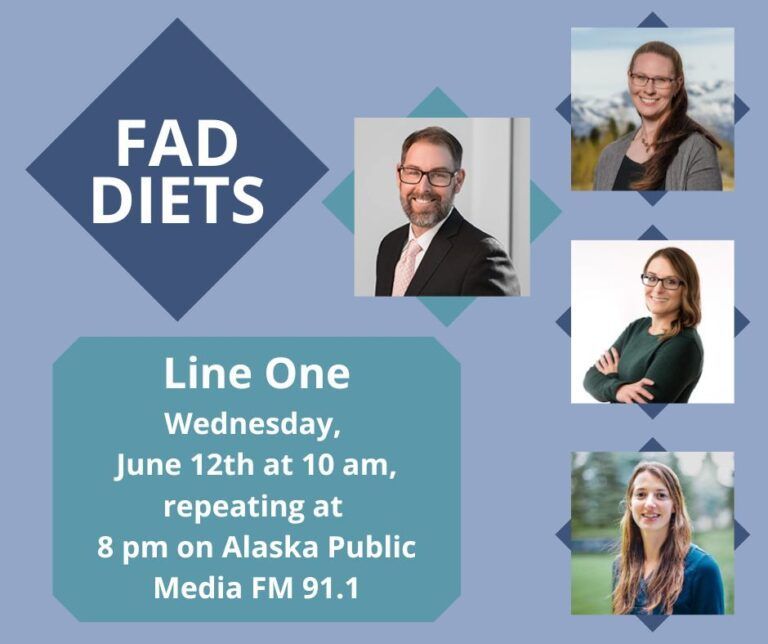
There’s a lot of reasons someone might want to change their diet. From conditions like diabetes, to celiac disease, or just the desire to lose or gain weight, the endless options of diets make it difficult to know what will work, and what’s actually healthy. That’s where the help of a registered dietitian can make all the difference. On this Line One, host Dr. Justin Clark talks with dietitians about how, and why, to change what you eat.
HOST: Dr. Justin Clark
- Erika Van Calcar, MS, RD, LD
- Soleil Thiele, RD, LD
- Staci Kloster, RD, LD
Click HERE to listen.
Continue for a transcription of the audio show.
Dietitians of Alaska | Line One
Dr. Clark: Hello, good morning and welcome to Line One, Your Health Connection. I’m your host, Dr. Justin Clark. I am very excited about today’s show on Line One and we will be answering all of your questions about diets. There are many reasons someone may want to change their diet, such as weight loss, diabetes, heartburn, or maybe GI disorders like irritable bowel syndrome, inflammatory bowel disease or celiac disease. There are also endless types of diets out there such as Keto, Atkins, low calorie, low fat, low carb, intermittent fasting, gluten free and FODMAP. However, changing your diet is one of the hardest things for people to do long term. Having the help of a registered dietitian can make a huge difference. Today, I am pleased to be joined by three registered dietitians from Dietitians of Alaska, Erika Van Calcar, Soleil Thiele, and Staci Kloster. You can also be part of our conversation. If you have a question or a comment, please give us a call toll free statewide at 1-888-353-5752. In Anchorage at 907-550-8433. That’s 907-550-8433 or you can email me at lineone@alaskapublic.org. Well, I want to thank you guys all for being here today. We’re going to start with Erika Van Calcar. Thank you for being with us. I want to give you a chance to introduce yourself to our listeners and tell us a little bit about yourself and how you got to be a registered dietitian.
Erika: Thank you so much. So, long story with a lot of history. This year, I am celebrating my 20-year anniversary of being a registered dietitian and my 10-year anniversary of moving up to Alaska. So, this is kind of a big year for me. I am a transplant from Washington State and I became a registered dietitian because I have a passion for talking to people about food and honestly because I was in community college and my parents kind of gave me an ultimatum – it’s either find a job or find a career. And so, I flipped through the course catalog and found my career and I haven’t looked back and it’s been wonderful.
Dr. Clark: That’s great. Sounds like that’s an awesome story. Twenty years, I can’t believe it. Okay, and then, Soleil, welcome to Line One. Thanks for being with us today.
Soleil: Thank you. I’m a newer dietitian. I got my license around three years ago and my first job was actually starting at Anchorage Bariatrics and now Dietitians of Alaska. Erika is basically my mentor. She’s kind of taught me everything I know pretty much. But yeah, that’s kind of about me. I’m originally from California, but now, here in Alaska, and I love it.
Dr. Clark: Good. Well, thank you for being with us here today. And finally, Staci Kloster, welcome to Line One.
Staci: Thank you. I was born and raised in Alaska, always been my home, likely always will be. Went to UAA through the dietetics program. Did the internship here in Alaska, got to do some rural community things, got to see the great State of Alaska while doing it. What led me to become a registered dietitian was many, many moons ago, I was diagnosed with Crohn’s disease, and that just gave me a passion that, kind of one mold doesn’t fit everyone when it comes to their diet. So, that has led me down the career path of being a dietitian.
Dr. Clark: Great. Well, that personal experience certainly comes in handy with the patients you see, I imagine.
Staci: Yes, it does.
Dr. Clark: So let’s start with the basics. When someone says registered dietitian, Erika, I’ll start with you since you’re the senior partner here. But, what’s a registered dietitian? What do you consider it to be?
Erika: That’s a great question. And I defer back to, I guess, what a registered dietitian is technically speaking, because it is kind of confusing on social media. If you look online, it feels like the words “registered dietitian” and “nutritionist” are used fairly interchangeably. I think that’s where a lot of the confusion lies – is that a registered dietitian can also be a nutritionist, but a nutritionist can’t necessarily be a registered dietitian. There’s a little division in terms of credentialing there. So to be able to use the title of “registered dietitian” you need to have a bachelor’s degree in a related field, like food science and nutrition, myself as an example, from an accredited institution. You have to complete 1200 hours of supervised and accredited work experience internship, you have to pass a nationally recognized exam that is regulated by the Commission on Dietetic Registration, and then every five years, you need to complete 75 hours of continuing education from approved sources, which includes at least one hour of professional ethics. So, there’s a lot involved there. To use the title of “nutritionist” is where it gets a little sticky. Every state is a little bit different. Some states have rules and regulations, some states don’t. So in those states, Joe Blow off the street, could say, “Hey, I’m a nutritionist” and, you know, there’s no regulation around that. Fortunately, up here in Alaska, we do have regulations. So you can go on to the state of Alaska website and actually look up what those regulations are. You can also do a licensure search for either a registered dietitian or a nutritionist. So, if you’re going to go talk to somebody, you can look up to make sure that they’re legitimate, they’ve done these things and they’re licensed in the state.
Dr. Clark: That’s very interesting. And so, Staci, we’ll flip to you next. I think you’re the most recently through the program. How long is the training to become a registered dietitian? And I guess we’ll start there.
Staci: So things have definitely actually even changed since I came through. Whereas now, in order to become a registered dietitian, you actually need to have your master’s degree. Up until 2024, if I am correct, you didn’t have to have a master’s degree. So some of the internships that have now kind of morphed into the master’s program, there is one here at UAA. I know that when I was going through the program, they were offering that as an option, but you essentially had to complete your exam by a certain date of 2024. Otherwise, else, you needed a master’s degree. So things are kind of changing on the horizon as far as the credentialing or schooling that you need to do now. It’s a bit longer.
Dr. Clark: So, Soleil to talk a little bit about the nutritionist versus dietitian and you can put this if you want, but what do you see either from your patients asking or from your own education about what are the the two differences in what a nutritionist will do for you versus a registered dietitian?
Soleil: Well, dietitians are the experts on nutrition. Nutritionist, it’s hard because there are some nutritionists out there who do go through programs you have to pay for and they can give good general nutrition advice. What a nutritionist can’t do is they can’t provide new medical nutrition therapy. So if someone has diabetes or heart disease or something like Crohn’s disease, that person would probably want to go see a dietitian because they’d be able to give you better medical advice compared to a nutritionist where they don’t learn that through their nutrition programs, through something like personal training certifications and things like that. So that’s, I would say, the main difference between a nutritionist and a dietitian.
Dr. Clark: Excellent. Erika, anything to add to that?
Erika: No, I think that about covers it.
Dr. Clark: Good. So, it sounds like the training is quite involved. I mean, you said 1200 hours of actual internship and I imagine that involves several different aspects of nutrition. So there’s inpatient and outpatient and all of you guys are outpatient therapists, so working with patients outside the hospital. But does your training also involve working inside the hospital? Start with Erika.
Erika: Yes. With my internship, I did it at Case Western Reserve University in Ohio. And then that was where, because I have a master’s, and so that’s kind of where the master’s program went. The University Hospitals of Cleveland is where I did most of my internship and I would say, a good 80% of it was actually in hospital work. I was in the ICU, I did the NICU, I did the PICU, General med surg floors, hemodialysis units, so yep, all over. There’s quite a bit of time you actually spend in the kitchen as well, so it’s a lot of everything.
Dr. Clark: Good. Well, let me give our listeners our calling numbers again and then we’re going to get into the nitty gritty of these calories and diets and stuff, which I’m excited to hear about. The caller number statewide is 1-888-353-5752. In Anchorage, 907-550-8433, or email at lineone@alaskapublic.org. Okay, well, we do have an email, and I want to get to that in a minute. That’s regarding diet and cancer. But let’s get some of the basics out of the way first. And so, Staci, I think you’re up here. What is a calorie?
Staci: In the most basic form, the amount of energy that is released by the body when you ingest something. So, when you look at nutrition labels, and you see that a food has X amount of calories, then it is the amount of energy that that food is going to give you.
Dr. Clark: Awesome and so it’s very complicated.
Staci: It definitely can be and I think that’s also going back to perhaps dietitian versus nutritionist, then also to the amount of science that is needed to become a registered dietitian, is oftentimes very shocking. The amount of just science behind it all.
Dr. Clark: And I’m always curious, I mean, because calories are a standard thing. So it’s a standard amount of energy, or, you know, as you described it, but then, people burn calories very, very differently. So it doesn’t exactly correspond to one person’s particular amount of energy expenditure. Would that be okay to say?
Staci: Yes, I also think that skipping ahead, when we see the 2000 calories a day, it doesn’t fit the mold for everybody, because everybody is burning and taking differently.
Dr. Clark: Let’s talk about that. Soleil, what’s your feeling on this 2000-calorie a day diet? Like, where did that even come from? I mean, is there any history behind it? Is there any utility to it? Or is it just like a good number to use?
Soleil: I don’t know. I literally don’t know the history. I’m sure Erika probably researched that better than I did. But like Staci said, I mean, throwing 2000 calories at someone, that is not individualized whatsoever – everyone’s metabolism is different. You have to think about total daily energy expenditure, which is your basal metabolic rate, your resting metabolic rate, the thermic effect of food for instance, protein. You take less calories from protein and other foods, so that’s why like protein, heavy diets are sometimes a good thing, but there’s a lot that goes into it. Everyone is so different. You can’t just slap a number. Like, if you sign up for my fitness pal, a really popular tracking app, it usually spits a number at you and it’s like, okay, why is this number being spit at me right now? Erika might have more information on the 2000 calories.
Erika: I want to say that it goes back to the old food guide pyramid needing to give just a general guideline and just use something. I think that that’s where the 2000-calorie diet example came from. And really, where it’s used more often is on food labels. You’ll see the food label and give you the serving size, the number of servings per package, and then it goes down and grams of fat, grams of sodium, grams of protein and then on the very far right, it gives you these percentages, which are horribly confusing. But, they’re all percent that will give you based on a 2000-calorie diet, which for most of us, is just not applicable. So, I’m actually kind of surprised that they haven’t gotten rid of it by now. Just because not many of us eat exactly 2000 calories every day.
Dr. Clark: Yeah, I imagine there has to be some sort standard or, I mean, not per person, but in order to generalize a food label. I’m sure they had to pick some sort of number. But well, before we get into some more interesting questions, I wanted to ask you guys about an email here from Larry. A little complicated, but Larry had prostate cancer and he wanted to know if there was any particular diets that are used to per se, suppress cancer growth or spread, or also hormone driven cancers, like breast and prostate. Just to give some background, he’s also a type 2 diabetic with a BMI of 23. So, any thoughts for Larry and we’ll start with Erika, here. Tough question, but I’m sure there is some science behind this.
Erika: Yeah, one of my rotations was actually in an oncology unit. But Larry, forgive me, it’s been 20 years, since I’ve worked in oncology. For most cancers, there’s no good solid, peer-reviewed research on this particular diet that would help to suppress, prevent and cure cancer. There’s a lot of good correlation or connection, let’s say, between a more Mediterranean way of eating, more whole food, less processed food. But specific – a specific diet, specific foods, not that I recall.
Dr. Clark: What about things like, per se, what they call now super foods or something or low oxidative stuff? Is there any utility, I imagine it’s not bad, but is there anything specific that would help? You know, maybe suppress or….
Erika: Again, this is just my opinion, but I think almost every food can be a superfood on its own right. Every food from the blueberry to the watermelon to the carrot to the chicken breast. If you want to continue down the road of superfood, it has its own superpower, it has its own benefit at its own right. I think the trouble we run into with labeling something a superfood is that people tend to then fixate on that one particular thing and it’s going to be “the thing” at the expense of everything else. I think that’s doing the individual a disservice. I think you’re eating again, more whole foods, less processed food, and a wide variety is going to do the individual a better service.
Dr. Clark: So pose the same question. Soleil, Staci, any thoughts on diets for cancer related things?
Staci: This is Staci speaking, but I have to agree with Erika just as far as the Mediterranean diet. It seems like in a lot of research, things go back to the Mediterranean diet, mainly for that kind of whole food approach. If you think of having an apple versus having some apple juice, trying to have things that are less processed, whole foods, you’re gonna get kind of more of that superpower from that food. But also, like Erika said, I don’t think that there is one very specific honed-in diet that is going to cure all of those things that we want a diet to do for cancer.
Dr. Clark: Okay, awesome. I remember someone telling me once and I can’t remember who it was, but as you know, there’s vitamins and maybe we’ll get into that if we have time. But, you know, they’re like, it’s not the beta carotene and the vitamin, it’s the carrot. It’s eating the carrot that provides the benefit, not the individual supplement that comes out of the carrot. Does that make sense? Soleil?
Soleil: I think getting the whole form of a food is the best thing you can do. That’s where you’re getting the fiber and the nutrition like you’re talking about. I want to add to the cancer thing. Eating enough, especially if you’re going through cancer treatment, a dietitian can help with making sure you’re getting the right amount of calories and nutrients. Because going through cancer treatment, there’s muscle wasting that sometimes happens there depending on what kind of cancer you have. And so I think just eating enough, even if it’s through liquids, I think is super important. We don’t want wasting, so just making sure you’re getting the calories in there.
Dr. Clark: Good. Well, we’re going to take a quick break. You’re listening to Line One, Your Health Connection. If you have a question or a comment for our guests today, call us statewide at 1-888-353-5752 or in Anchorage at 907-550-8433. After the short break, we’ll continue our discussion on everything diet related with Erika Van Calcar, Soleil Thiele, and Staci Kloster from Dietitians of Alaska.
Welcome back to Line One, Your Health Connection. I’m your host, Dr. Justin Clark. I’m joined today by registered dietitians, Erika Van Calcar, Soleil Thiele, and Staci Kloster from Dietitians of Alaska. Do you have questions about what a calorie is? Or how many calories a day are recommended? What about if tracking your diet is effective? If you have a question or a comment, call us toll free statewide at 1-888-353-5752 or in Anchorage at 907-550-8433 or email us at LineOne@Alaskapublic.org. Okay, so I got some more fun questions for you guys. I want to know about macros. I hear all the time you need a certain number of macros or the breakdown of the calories. Who wants to start here and describe what a macro is? No one is raising their hand. So I’m going to say Soleil. What is a macro?
Soleil: So macros are three things that all foods have – carbs, carbohydrates, fat, and protein. There are suggestions for those. General suggestion is getting 45% – 65% of your calories from carbohydrates, 20% – 35% of your calories from fat and 10% – 35% of calories from protein. Very general, but that’s basically the gist of what macronutrients are.
Dr. Clark: Okay, so every food or I mean not every food but almost all foods are going to have three different components to them. And then you collect these up throughout the day, saying in general, your general diet should have a percentage of each of these. Okay, so let’s get into each of them a little bit because it’s so confusing to me anyway. Erika, okay. What is a carbohydrate?
Erika: So, a carbohydrate – think of it as if we’re using gasoline as an example. It’s almost like the nitrous oxide that you would put in a sports car to make it go really fast. It’s probably the most easy to access energy in a food. From that, there are different classifications of carbohydrates – there is a complex carbohydrate and there is a simple carbohydrate without getting into the chemistry of everything because we don’t want to do that. Basically, think of a complex carbohydrate as coming the way nature packaged it. So, like a bowl of potato out of the ground, that is considered a complex carbohydrate – it has fiber, it has a little bit of water, it’s gonna take longer for the body to get through it. Brown rice would be another example of a complex carbohydrate and apple could be another example of a complex carbohydrate. Then, you have simple carbohydrates. Basically, those just don’t take as much to get digested and converted into energy by the body. The best example of a simple carbohydrate could be just regular table sugar. It doesn’t take long at all for the body to break it down. That’s why it’s so good to use it with somebody who’s diabetic, who’s having low blood sugar. It takes very little time for that carbohydrate, that energy to get into the bloodstream. And so, we’ve got the whole food carbohydrate, we’ve got the more processed food carbohydrate, neither one of those is good or bad, because food does not have morality. It just is what it is. But, it’s generally recommended that the diet contain more complex carbohydrates than it does simple or more processed carbohydrates.
Dr. Clark: Okay, so it’s like white rice would be like a simple carbohydrate or like candy bars?
Erika: Candy bar, yes. I think you know, white rice, and I’m glad you brought that up, it is more processed. To make white rice, you have to take off that fiber-rich hull and they did that back, I want to say, like World War 1, 2, to make it more shelf stable. So it’s sat on the shelves here longer, could be transported, you know, overseas to the soldiers and wouldn’t go rancid. So it’s going to be digested quicker, but that’s not to say that it shouldn’t be consumed. I mean, most cultures nowadays do use white rice or a form of white rice. So that’s kind of a sticky area.
Dr. Clark: Well, I see what you did there. And I like it. Okay, so Staci, you get the fats. Okay. But first, you can comment on anything carb related and then you can add in the fats.
Staci: I did want to comment on carb-related only because when it comes to simple and complex carbohydrates, I think in general, when kind of like the 2000 calories suggestion, it’s more of like the general population. Just going back to like having Crohn’s, for somebody who has a GI disorder, oftentimes, having those more complex carbohydrates isn’t the best thing for my body. Being able to recognize that, having a dietitian walk you through that, that doesn’t mean I always have to have the apple sauce, but maybe I could peel the apple and not have quite as much fiber. Kind of those little hidden gems to make it more individualized so that you still get the whole food but maybe not the whole food. So fat is up to me, oh gosh.
Dr. Clark: I look at a label and I see saturated, unsaturated, trans fats. I don’t know the difference, like what’s good? What’s bad?
Staci: I think fats have been very popular in the diet world with the keto diet, if I might say that word on radio, I’m sure we’re gonna get into that. But with fats, knowing the difference between healthy fats, getting things from like, nuts, avocados, salmon, versus having some of those fats that you’re getting through more processed foods, I think it goes back to that. Having whole foods versus the processed foods still applies with that fat. Thinking that, just going on a very basic level of trying to eat fats from whole food sources as opposed to going to the more processed, then you should be ahead of the game.
Dr. Clark: Okay, so, before I go to protein with Soleil, we have a call from Trevor in Anchorage. Trevor, welcome to Line One.
Trevor: Thanks, loving the conversation. You know, my big question is about health related to and nutrition related to milk. Milk from the cows, there’s different types and then you add all the nuts and the oats and all these others, and really just trying to understand what are the health benefits of one over the other and how to best select it?
Dr. Clark: Well, that’s a great question, Trevor. I will pose that here to our dietitians. I’ll have you take the answer off the air. Okay, so just to summarize, for everyone, there’s cow milk and I know there’s fat-free, low fat, whole milk, a bunch of additives and then there’s oat and soy and coconut and all the other types of milk. So, who wants to tackle this question? Again, no hands, but everyone’s looking at Staci.
Soleil: I was gonna say, Staci, because there’s fat and milk. I mean, that’s a big part of it. But there’s also carbs and there’s also protein, so they have all those macros.
Staci: That is where again, I’m going to go individualize that A) can you process lactose that isn’t milk? If you can’t, then that takes some cow milk off of the table. So that would probably…if you get GI upset, if you have like constant diarrhea, then you’re intaking something that you’re not going to be absorbing and getting the nutrients from anyways. So then, having those alternative milks would be probably a better healthy alternative for you. If you are like me, and I just don’t like the taste of milk, so it’s hard for me to get over that, then I turn to alternative milks. But, what am I looking for in my diet? Am I looking for something that is going to give me some of those carbohydrates? Am I looking for something that’s going to give me a little bit more protein? Because maybe that’s harder for me to get, then that would be kind of more the direction. It’s very hard to recommend a product if the person, the patient, doesn’t actually like it. It doesn’t really matter whether it is the most super food, everything that is in my fridge, on my counter, but if I won’t physically eat it, it really doesn’t do me any good. So, I think also pairing that with what you like or can tolerate is a big component to it. I’m not sure if that answers your question or not.
Dr. Clark: I think it does. It depends a lot on what someone can tolerate and what they like and there’s not necessarily a bad product or a good product. What I’m hearing today is, everything is individualized and if you truly have questions that you want individual answers to, then you have to see a registered dietitian. Would that be a fair statement?
Staci: Yes.
Dr. Clark: Okay, well thank you Trevor, that was a great question. I have another email I want to get to, but I want to give Soleil her opportunity to discuss the protein and any comments on carbs and fats.
Soleil: Okay, the only thing I’ll say about carbs is that carbs are not the devil. I feel like everyone thinks carbs are the worst thing and you shouldn’t be eating carbs. They’re so so so so so important, especially if you exercise, and the fiber there with the complex carbs that Erika discussed. Carbs aren’t the devil, most diets out there these days, like keto, they cut out the carbs. I don’t agree with that personally. Everyone’s different, of course, but yeah, I just think carbs are important and everyone should be eating carbs. So that’s what I’ll say. Protein wise, I think protein is just as important. Protein is the building blocks of muscle. It’s the building blocks of enzymes that your body uses, like, literally, your body uses every bit of protein that you eat. And you can get protein from numerous sources, it doesn’t just have to be your meat, your fish, which are great sources, but you can also get protein through plant foods to beans. Tofu is a great source. What else, lentils, veggie burgers, and things like that out there these days. But yeah, I guess that’s kind of the gist of protein. Very important to, again, maintain that muscle mass. I think that it’s super important to maintain the muscle mass for your life, because at some point, you do start to lose your muscle as you get older and older. So you want to have as much muscle as you can to prevent being frail or anything like that in your older years.
Erika: Everyone’s looking at Erika, for some reason.
Dr. Clark: You’re not that old, Erika.
Erika: I’m the oldest one in the room.
Dr. Clark: I know Staci has a comment on that. But I’m going to ask you this Soleil, because I left protein to you specifically, can you get enough protein if you are a vegetarian?
Soleil: 100%. Yes. Like I said, tofu, lentils. I do something called Seitan, which sounds funny, but it’s basically wheat gluten. So obviously, if you have celiac or you don’t tolerate gluten, this wouldn’t be something for you, but packed with protein and incredible amounts of protein. Of course, protein powders are out there too. I definitely have a protein shake most days or just a scoop of protein and something that’s helpful, but there are some things you have to consider. The amino acids are very important for building your muscle. One of them is called leucine, it’s one of your vital essential amino acids. Typically plant proteins aren’t as strong in that compared to your meat-based proteins, dairy based proteins. But still, you can definitely get your protein and it’s not a problem at all.
Staci: Moreso, the comment that I just wanted to make, just because we had talked about calories, is that, to note that both carbohydrates, protein, they both have four calories per gram, whereas fat has nine. So, I just wanted to throw that out there since we had also mentioned calories. If you are thinking of the 2000 calorie diet or 2200, whatever the case may be, what your ratios would be and how many calories you’re gonna get from each one of those macronutrients.
Dr. Clark: So, you don’t have to eat a lot of fat to hit a lot of calories. Okay. All right. I have an email here from Deborah. So this will piggyback a little bit on your frailty comment Soleil, but she wants to know if there’s specifically diets for seniors as people get a little bit older and in (let me read the rest of her email), but it seems like there are certain foods that are more problematic as you get older and she’s specifically saying they want her to eat higher fiber foods. But eating higher fiber foods like later in the day causes problems. So are there any diet suggestions for, I guess, for seniors would be the general question. And Erika, since you’re the senior of the room, as you pointed out, I will post this to you.
Erika: Low blow! Just understanding the question, Deborah is looking for a general kind of diet advice for as you get older?
Dr. Clark: It seems as if it takes longer to digest my food as I age. Particularly problematic seems to be eating high fiber foods later in the day, while at the same time needing to eat more high fiber foods.
Erika: I gotcha. I think that we can definitely give, you know, kind of general stuff now. This may be another good opportunity to just, maybe even like one appointment with a dietitian. Because then, you and either he or she, because dietitians can be men, you can go over the particular foods that you’re eating. There may then be some suggestions. Okay, this and this are causing you issues, let’s just hypothetically, say like broccoli, cabbage, which tend to be fairly high in fiber, some of the common gassy vegetables. And so, it can cause some GI upset, bloating, gas, maybe even diarrhea, and a dietitian could then work with you and say these may also be good choices, but may cause less GI upset. Another example with fiber could be beans. Beans are really high in fiber, but if you think about your black bean, your red bean, your kidney bean, sometimes those can cause a lot of gas. Lentils tend to be fairly comparable in terms of fiber, but not as gassy. Like Staci was saying with the apple and Crohn’s Colitis. Even a peeled apple still has quite a bit of fiber, but you’re taking away some of the insoluble fiber and leaving more of the soluble fiber. My dad calls it “defarting the apple”, which is kind of a beautiful example and those who know, you just know. So, it may be for Deborah, taking a look, just like writing down what foods are causing her an issue and then meeting with somebody to just get different advice on okay, you know, these are some substitutions or things you can add to your diet.
Dr. Clark: Great. Well, we’re going to take our second and last little break here. You’re listening to Line One, Your Health Connection. If you have a question or a comment for our guests today call us statewide at 1-888-353-5752 or in Anchorage at 907-550-8433. After the short break, we will continue our discussion on everything diet related with Erika Van Calcar, Soleil Thiele and Staci Kloster from Dietitians of Alaska. Welcome back to Line One, Your Health Connection. I’m your host, Dr. Justin Clark. I am joined by registered dietitians, Erika Van Calcar, Soleil Thiele and Staci Kloster from Dietitians of Alaska. If you have a question or a comment, call us toll free statewide 1-888-353-5752 or in Anchorage, 907-550-8433, or email us at lineone@alaskapublic.org. We have a call from Kristen on line one. Kristen, welcome to Line One.
Kristen: Thank you. Thank you. My question is that as we’re going into the holiday season here, and people will be having get togethers and parties, what would be a good menu to set up for a nutritious and healthy, but still fabulous Christmas dinner?
Dr. Clark: Love it. Love it. Thanks, Kristen. Thank you for the question, Staci.
Staci: Well, I mean, if I had my choice, I would say some deer backstraps, some king crab and a side of shrimp. But, I do think when it comes to the holidays and you’re not just cooking for yourself, which I think sometimes can be a bit overwhelming, you’re trying to put on the presentation, feed the masses, appeal to the tastebuds, all of those things… I think incorporating your basic things where you have a protein, you have your carbohydrates, you have some healthy fats in there, and then you can’t really go wrong.
Dr. Clark: Okay, I like it. So what about a sweet potato souffle thing with lots of marshmallows on top?
Staci: Maybe marshmallows on half, for those who don’t want marshmallows, but….
Dr. Clark: Good. So there’s good proteins. There’s gonna be good proteins. You mentioned shrimp, I mean game meats, there’s always turkey and things like that involved, but also a good variety of carbohydrates, complex carbs, whole foods, less processed stuff.
Staci: Yes and I think sometimes we get into that – that everything needs gravy or sauce to make it decadent, when just some like perfectly steamed broccoli can go a long way. I think don’t try to overthink. It is my advice, I guess. Just make sure that you have a protein or maybe have a few different proteins, you have some healthy fats, you have some complex carbohydrates that if you want to try something different go for some quinoa or brown rice. If you’re looking for a new recipe, try something outside of the box that you don’t typically do.
Dr. Clark: Awesome. All right, Erika.
Erika: To piggyback on that, reminding folks that Christmas dinner, or even if we think back like Thanksgiving dinner, it’s just one meal. And so yes, I’m in 100% full support, and maybe not marshmallow the bejesus out of the already perfect sweet potatoes, or instead of two cans of cream of mushroom soup with the green bean casserole, if you can do it with one can and maybe a little whole milk. So making those changes, but then too it’s like, okay, this is just a meal… How can you set up the rest of that day, that week, to support whatever goal you have? So maybe the house isn’t full to the brim with cookies and pastries, that you find yourself being tempted with, or you’re having an agreement with your friends, your co-workers of the non-food presents, or having your guests take food home with them if you struggle with leftovers. So, I think doing what you can with your Thanksgiving dinner, or like the Christmas dinner, but also recognizing that it’s just one meal and you’re looking at the rest of the day, and the rest of the week, as well and just trying to, you know, doing what you can to make things look more balanced within that entire week.
Dr. Clark: Great. I think that’s great advice, as well. We have another call from Gene in Wasilla. Hello, Gene. Welcome to Line One.
Gene: Hi. How are you doing there?
Dr. Clark: Great. Great. What can we answer for you?
Gene: Well, I have a question about one of my favorite things. It is a salad with purple cabbage and carrots and then I put a lot of olive oil on it and balsamic vinegar. I’m wondering, these have been very good for me for when I want to lose a little bit of weight. What is the effect of olive oil on a diet like that? Does that help promote weight loss? What do you think is working for me or why is it working?
Dr. Clark: Yeah, yeah, that’s a great question, Gene. Thank you. I wonder if it’s partly you’re transitioning to just eating the salads too. It might be helping with some of the weight loss. But oils are not all created equal and so Soleil, why don’t we have you talk a little bit about olive oil or other oils or if there’s a weight or health benefit to the oils.
Soleil: Olive oil is definitely a good choice. It is part of the Mediterranean diet. It is considered anti-inflammatory. If you want to say that. When it comes to weight loss, you really have to pay attention to the oils because one tablespoon of olive oil is probably over 100 calories. Just that and if you’re not measuring, you could be doing four or five tablespoons of olive oil on your salad. That could be an extra 500+ calories you’re adding to your day, which could definitely lead to weight gain for some people. So, it’s a good choice – I would just say be mindful of how much you’re using and make sure you’re measuring it out a little bit better if you’re not measuring it. But yes, olive oil is a good choice. I think monounsaturated oils, olive oil, avocado oil is a good choice, especially if you’re baking something or grilling something in a pan. But when it comes to weight loss, definitely just be mindful of those fats as Staci said earlier, one gram of fat equals nine calories. So it can really add up for sure.
Dr. Clark: So it goes a long way. I mean, I heard at one point that, when researching the Mediterranean diet, that sometimes eating olive oil with bread, or carbohydrates sort of limits the absorption of the carbohydrates. Is there any potential truth to that? Or is that kind of just an old wives tale?
Erika: This is Erika. And yes, there’s some validity to that, in that fats and proteins do slow down digestion. And so, getting back to to the color, I think you’re on the right track in terms of just adding in the salad, the fiber. The salad sounds very fiber rich, very filling, very bulking, which gives you that initial sense of fullness, but then the fat in the olive oil helps to slow down digestion a little bit, so you feel more satisfied or more full, longer. Same with the bread, the fat is going to prevent the mixture of all that food. It’s going to prevent it from leaving the stomach faster than it would if you just ate the bread alone. Again, if we go back to talking about eating with diabetes, and we want to slow that release of carbohydrate, of sugar into the bloodstream, we tend to pair most things with protein. Most proteins contain fat, so you’ve got then to use a big word, that synergistic effect to slow things down.
Dr. Clark: That’s super interesting. So what I’m taking from this is that not all oils are created equal. There are some oils that are better like olive oil or avocado oil, things like that, rather than say, like vegetable oil, or canola oil or something like that. But you have to be careful because they are calorie dense. So, substituting that from like a ranch or something, could be good. But if you’re using more olive oil, then you may be negating the effects. Would that be fair to say? Got it? Well, gosh, the time has flown, we only have about three, four minutes left, we did not get to a lot of the specific diets. So it gives us a reason to have you all back on the show. Okay, the one thing I do want to hit in the last four minutes, because we’ve mentioned it several times, is keto. I know no one really wants to talk about keto, because it’s a hot subject. But, what’s the keto diet? Is it effective? Who would benefit? Anybody want to tackle this in three minutes?
Erika: This is Erika and I’m not sure if I can do that in three minutes. But, it is kind of my pet peeve. It is kind of my passion. I think I’m going to answer your question and I think it’s important with any, I’m going to use the word fad diet, that we understand the origins and I think the ketogenic diet is a beautiful example of that. In that, long story short, the ketogenic diet was first coined, I want to say in the early 1900s, by a doctor at, I believe, the Mayo Clinic for the treatment of pediatric epilepsy. It’s a medical diet, again, for the treatment of pediatric epilepsy. It was never intended to be for weight loss, or weight management. It came about as they looked at the management of seizures in children and young adults when they were fasted. They found that in the blood of these individuals, they found ketone bodies and it developed from there. It’s very restrictive. I had a patient actually not that long ago, or a few years ago now, whose son was actually on the ketogenic diet for pediatric epilepsy, and his diet was 90 percent fat. That’s a lot of fat, so restrictive. In about 2003 is when they finally started to use a modified Atkins diet because it is lower in carbohydrates. It is going to put an individual in that ketogenic state to get those ketone bodies released which – don’t ask me what it does to the brain, but so that people could eat a less restrictive diet. How then that worked its way into kind of the mainstream, Staci and I were actually looking for a timeline before we showed up here and…
Dr. Clark: Well, I guess you got out of that question Erika. We have to roll up here. If you want to see a registered dietitian, you can go to their website at dietitiansofalaska.com or call 907-644-8445. Special thanks to our guests for being with us today. Registered Dietitians, Erika Van Calcar, Soleil Thiele, and Staci Kloster from Dietitians of Alaska. Thanks to our audio engineer Chris Hyde and producer Madeline Rose. You can find more information on this and previous programs on our website at Alaskapublic.org. Let us know your thoughts or suggestions by emailing us at lineone@alaskapublic.org This has been Line One your health connection. I’m your host Dr. Justin Clark, stay healthy Alaska.
Announcer: Line One is a production of Alaska Public Media which is solely responsible for its content. Views expressed are those of the hosts and participants and not necessarily those of Alaska Public Media this station or its underwriters. Learn more about Line One and listen online at Alaskapublic.org. This is Alaska Public Media.
The post Line One: Dietitians of Alaska – Exploring Diets appeared first on Dietitians of Alaska.
Recent Posts